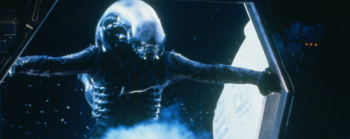


A new fan-made project is offering a fresh, deeply immersive perspective on James Cameron’s Aliens — not by retelling the story, but by reconstructing the world behind it.
Russian film director and European Film Academy member Pavel Golovin has completed a unique archival-style book titled Hadley’s Hope: Declassified Mission Files, a non-commercial project that presents the events surrounding LV-426 through the lens of internal Weyland-Yutani documentation.
Rather than functioning as a traditional narrative or fan fiction, Declassified Mission Files is structured as a four-part investigative dossier — designed to feel like a collection of recovered corporate and military records tied to the infamous Hadley’s Hope colony.

A Corporate View of the Aliens Timeline
The book unfolds across four distinct “acts,” each focusing on a different layer of the Alien universe mythos:
- Act 1: The Mission
Operational orders, crew dossiers, and internal documentation related to the Sulaco deployment. - Act 2: Ripley’s Secret
Confidential correspondence between Carter Burke and Weyland-Yutani leadership, alongside psychological evaluations of Ellen Ripley. - Act 3: The Truth
Recovered logs attributed to the Nostromo, including references to the “Cinderella Protocol” and a detailed military analysis of the Xenomorph as a bioweapon. - Act 4: The Tragedy
Documents tied directly to Hadley’s Hope itself — featuring the Jorden family contract, colony logs, and a psychological profile of Rebecca “Newt” Jorden.
Each section is presented in strict corporate style, complete with classification levels, technical breakdowns, financial records, and annotated notes — capturing the cold, procedural tone long associated with Weyland-Yutani’s portrayal in the franchise.
Built as “World-Building,” Not Fan Fiction
Golovin describes the project as “archival world-building”, emphasizing that it is not intended to rewrite or reinterpret Aliens, but to expand on its underlying structures — corporate decisions, military protocols, and the unseen administrative machinery behind the mission.
The format leans heavily into the Alien franchise’s established themes: corporate secrecy, ethical ambiguity, and the commodification of the Xenomorph as a potential weapon.
A Professional Approach to a Fan Passion Project
While Hadley’s Hope: Declassified Mission Files is a fan-driven work, it comes from a creator with an established background in film and publishing.
Golovin’s previous publications have been acquired by major libraries across multiple countries, and his production company, Eternity Pictures, operates an international film festival supported in part by the Stan Winston School of Character Arts.
That professional experience is reflected in the project’s attention to detail and presentation — particularly in its document design and structured narrative approach.
Early Community Reception
Prior to its wider release, the project has already circulated among members of the Alien fan community, drawing interest from established fan platforms and creators.
Feedback has highlighted the book’s focus on environmental and technical detail — particularly its exploration of Hadley’s Hope itself, a setting that remains one of the most analyzed locations in the franchise.
Available Free to the Community
In a move that aligns with its non-commercial intent, Golovin has offered the complete digital edition of Hadley’s Hope: Declassified Mission Files to Scified’s community as a free download.
The project is intended to serve as both a standalone experience and a potential reference point for deeper discussions around Aliens lore — particularly for fans interested in the corporate and logistical framework of the universe.
Scified will be hosting the full file in its resources section, making it accessible to fans looking to explore a different angle on the events of LV-426.
Fans interested in diving deeper into the hidden mechanics of the Alien universe can download Hadley’s Hope: Declassified Mission Files now and explore the tragedy of LV-426 through the eyes of Weyland-Yutani.
As part of this release, Golovin also shared an exclusive commentary with Scified, offering insight into the creative process behind the project:

Exclusive Commentary: The Creation of the "Hadley’s Hope" Archives
By Pavel Golovin
When I first watched Aliens at a young age, I was struck not only by the action but also by the world-building. James Cameron created a universe that felt lived-in, industrial, and brutally realistic. Every prop, every uniform, every computer screen told a story.
Years later, as a director myself, I began to wonder: what would actual documents from that world look like? And how would the bureaucracy of that world function?
Hadley’s Hope: Declassified Mission Dossiers is my answer. This is not a novel. It is an archive — a collection of “leaked” Weyland-Yutani corporate files, presented as if they had just been declassified after 50 years.
My research process was meticulous. For example, I studied real military operation orders (NATO standard), as well as psychological evaluation formats used for personnel in combat environments. Every detail — from weapons serial numbers to payroll calculations — was designed to feel authentic and grounded in reality.

Golovin’s approach to Hadley’s Hope: Declassified Mission Files reflects the same attention to detail that has long defined the Alien franchise itself — grounding its horror in realism, systems, and the quiet machinery behind catastrophic decisions.
For fans interested in exploring the deeper structure of the Aliens universe — from Weyland-Yutani’s corporate reach to the final days of LV-426 — the archive offers a unique, document-driven perspective on one of sci-fi’s most iconic settings.
Visit the Alien Day blog here for the latest coverage on all things happening for Alien Day!
This article follows our editorial guidelines for accuracy and canon consistency.